
How Thunder Atmospheric Water Generator Produces 150 Litres of Drinking Water from Air
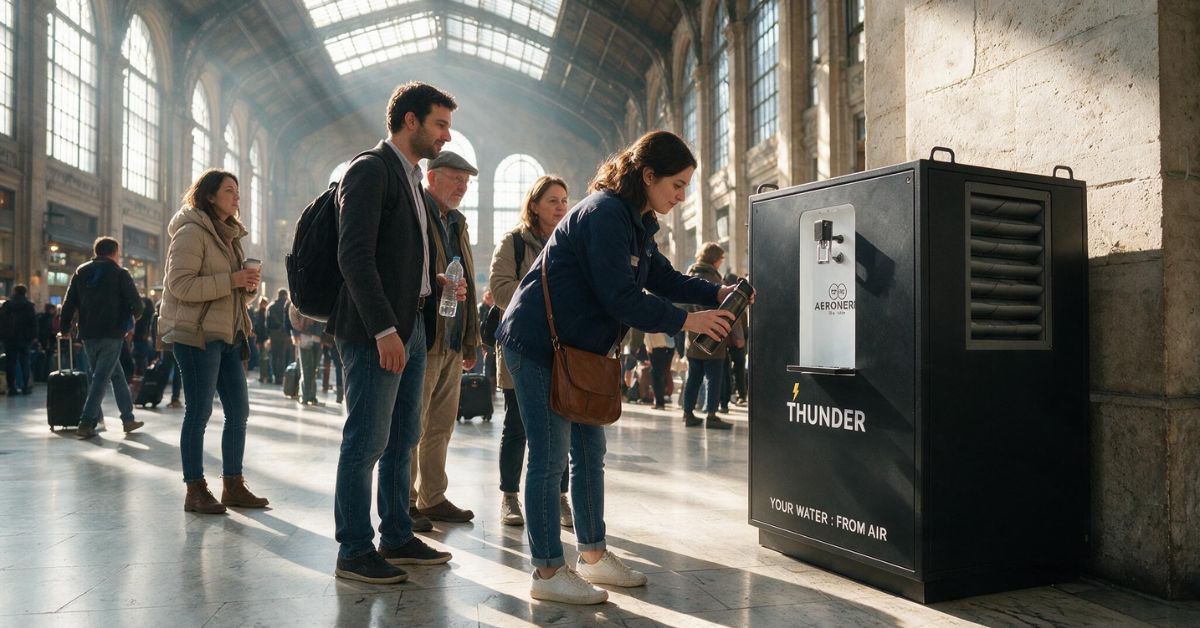
Imagine having the ability to generate drinking water directly from the air surrounding your facility. No tanker deliveries, no dependence on conventional groundwater sources, and no need to transport large quantities of bottled water.
This is the idea behind Atmospheric Water Generation (AWG) technology.
Aeronero Thunder is a high-capacity air-to-water generator designed for commercial and industrial applications. It can produce up to 150 litres of clean, alkaline, mineral-rich drinking water per day under specified conditions of 80% relative humidity and 30°C. The system is designed for applications including communities, NGOs, offices, factories, educational institutions, hospitals, and other large-scale facilities. (Aeronero)
But how can a machine actually produce drinking water from air?
The answer lies in the natural presence of water vapour in the atmosphere and Aeronero's patented ConDessa™ Technology. Thunder draws in atmospheric air, filters it, extracts moisture through cooling and condensation, and then subjects the resulting water to multiple purification stages before mineralisation.
In this guide, we'll explain exactly how the Aeronero Thunder atmospheric water generator works, how it can produce up to 150 litres of water, what purification stages are involved, and why air-to-water technology is becoming an important option for commercial and industrial water needs.
What Is an Atmospheric Water Generator?
An Atmospheric Water Generator, or AWG, is a technology that extracts water vapour naturally present in the atmosphere and converts it into liquid water.
The basic principle is similar to what happens when water droplets appear on a cold surface on a humid day. Moisture in the surrounding air comes into contact with a sufficiently cool surface and changes from vapour into liquid water.
An AWG takes this natural process and controls it through engineered equipment.
The overall process can be simplified as:
Atmospheric Air → Air Filtration → Cooling & Condensation → Water Filtration → UV Purification → Mineralisation → Drinking Water
Aeronero Thunder uses this principle through its proprietary ConDessa™ Technology, which is designed to replicate aspects of the natural water cycle while generating water at a commercial and industrial scale. (Aeronero)
How Much Water Can Aeronero Thunder Produce?
The key feature of Thunder is its production capacity.
According to Aeronero's current product specifications, Thunder can generate up to 150 litres of water per day at 80% relative humidity and 30°C. (Aeronero)
That capacity makes Thunder different from smaller household atmospheric water generators.
A system producing 150 litres per day can potentially support drinking-water requirements across environments such as:
- Factories
- Hospitals
- Schools and educational institutions
- Offices
- NGOs
- Communities
- Commercial facilities
- Institutional campuses
The actual production rate depends on operating conditions. The manufacturer's stated 150 L/day capacity is specified at 80% relative humidity and 30°C, so users should evaluate expected output based on the climate and conditions where the system will operate. (Aeronero)
How Does Thunder Make Water From Air?
The process behind Thunder can be understood through six primary stages.
1. Air Filtration
The process starts with the surrounding air.
Thunder draws atmospheric air into the system, but air can contain dust, airborne particles, and other contaminants. Before extracting moisture, the incoming air passes through an air filtration stage.
Aeronero states that this stage removes dust, airborne particles, and other contaminants from the incoming air. (Aeronero)
This creates a cleaner starting point for the atmospheric moisture-generation process.
It is important to understand that Thunder isn't simply collecting water vapour from untreated air. The air itself is first processed as part of the overall system.
2. Cooling and Condensation
After filtration, the air moves into the cooling and condensation stage.
This is where atmospheric water vapour becomes liquid water.
Air naturally contains invisible moisture. When the filtered air is cooled to an appropriate temperature, water vapour condenses into droplets.
Those droplets are collected as fresh water and moved into the subsequent treatment stages.
Aeronero describes this stage as cooling filtered air to extract atmospheric moisture and convert it into fresh water. (Aeronero)
This is the central principle behind an air-to-water generator.
In simple terms:
Moisture in air + controlled cooling = condensed water
The technology then takes that collected water through several additional purification stages.
3. Pre-Carbon Filtration
Generating water from atmospheric moisture is only the beginning.
The resulting water must be treated before it is intended for drinking.
Thunder includes a pre-carbon filtration stage.
According to Aeronero, this stage helps remove chlorine, odours, and organic contaminants, contributing to cleaner and better-tasting water. (Aeronero)
Carbon filtration is commonly used in water-treatment systems because activated carbon can help reduce compounds associated with taste, odour, and certain organic contaminants.
This stage therefore improves the quality of the water after it has been generated from atmospheric moisture.
4. Post-Carbon Filtration
Thunder also includes a post-carbon filtration stage.
Aeronero describes this stage as enhancing drinking-water taste, removing residual odours, and helping ensure fresh, clean water. (Aeronero)
Using multiple filtration stages provides a layered approach to water treatment.
Rather than relying on one filtration step to handle every potential issue, different stages contribute to the overall purification process.
For commercial and institutional environments, this multi-stage approach is particularly relevant because drinking water needs to be consistent, properly treated, and maintained according to applicable standards.
5. Ultra-UV Purification
The next stage is Ultra-UV purification.
Water quality is not only about particles, colour, or taste. Microorganisms are another important consideration when producing drinking water.
Aeronero states that Thunder's Ultra-UV purification stage is designed to eliminate bacteria and other harmful microorganisms. (Aeronero)
UV treatment adds another barrier within the overall purification process.
The combination of filtration and UV treatment means that Thunder's water-generation process isn't simply based on condensation. It incorporates additional treatment technologies designed to prepare the generated water for drinking-water applications.
6. Mineralisation
The final stage in Thunder's listed process is mineralisation.
Once water has been generated and purified, minerals can be added to create a balanced drinking-water profile.
Aeronero states that its mineralisation stage enriches the water with essential minerals and maintains an alkaline pH of 7.0–8.5. (Aeronero)
This is significant because the goal is not simply to collect water from the atmosphere.
The goal is to produce clean, mineral-rich drinking water.
Mineralisation can also contribute to the taste and overall characteristics of the finished water.
What Is ConDessa™ Technology?
Thunder is powered by Aeronero's patented ConDessa™ Technology.
Aeronero describes ConDessa™ as the technology behind its atmospheric water-generation systems, designed to replicate the natural water cycle through engineered moisture extraction and purification. (Aeronero)
The technology is central to the process because the challenge with atmospheric water generation isn't proving that moisture exists in the air.
The real challenge is developing a system that can:
- Capture atmospheric moisture
- Convert it into liquid water
- Maintain consistent operation
- Purify the generated water
- Manage energy consumption
- Scale production
- Operate in real-world environments
Thunder brings these concepts together in a system designed specifically for commercial and industrial use.
Why Does Humidity Matter?
One of the most important factors in water-from-air technology is humidity.
Air contains different amounts of water vapour depending on temperature and relative humidity.
Thunder's stated capacity of 150 litres per day is based on 80% relative humidity and 30°C. (Aeronero)
This means the maximum stated production should not be interpreted as a guaranteed output under every environmental condition.
For businesses considering an atmospheric water generator, it is important to assess:
- Average relative humidity
- Temperature
- Seasonal variations
- Daily drinking-water demand
- Available electricity
- Installation environment
- Required storage capacity
Understanding these factors helps organisations determine whether the system is appropriate for their specific location.
Thunder's 100-Litre Water Storage Capacity
In addition to its atmospheric water-generation capacity, Thunder has a 100-litre tank capacity according to Aeronero's current specifications. (Aeronero)
This provides an important buffer between water production and immediate consumption.
Water demand in a commercial facility isn't necessarily constant throughout the day.
For example, an office may have higher consumption during working hours, while a hospital or community facility may have different demand patterns.
Having an integrated storage tank allows generated water to be available for dispensing rather than requiring production and consumption to happen at exactly the same moment.
Thunder Is Designed for Commercial and Industrial Applications
Unlike compact AWG systems designed primarily for individual households, Thunder is positioned as a commercial and industrial atmospheric water generator.
Aeronero specifically identifies applications including communities, NGOs, offices, factories, educational institutions, hospitals, and other large-scale environments. (Aeronero)
This makes Thunder suitable for organisations that need a more substantial daily drinking-water supply.
For example, a factory may need drinking water for employees across multiple shifts.
A school may need water for students and staff.
A hospital may require reliable access to drinking water across different departments.
An NGO or community project may need a decentralised water source in a location where conventional water infrastructure is limited.
Reducing Dependence on Conventional Water Sources
One of the major advantages of atmospheric water generation is decentralised water production.
Traditional drinking-water systems often rely on pipelines, groundwater, tankers, or packaged water.
These systems can be affected by:
- Infrastructure limitations
- Water shortages
- Transportation requirements
- Supply disruptions
- Storage constraints
- Local groundwater availability
An AWG provides another option.
Aeronero describes Thunder as a sustainable and dependable water source intended to help communities and institutions reduce reliance on conventional water supplies. (Aeronero)
This doesn't mean an AWG eliminates the need for every traditional water source.
Instead, it provides an additional decentralised source of drinking water.
How Thunder Can Support Water Independence
The concept of water independence is becoming increasingly important for businesses and institutions.
Instead of relying entirely on an external supplier, organisations can generate a portion of their drinking water on-site.
Thunder's ability to generate up to 150 litres per day makes it particularly relevant where daily drinking-water requirements are substantial but do not justify a much larger industrial water plant. (Aeronero)
Potential benefits include:
Local generation: Water is produced at the point of use.
Reduced logistics: Organisations can potentially reduce dependence on water deliveries.
Less packaged water: Reusable containers can be used for dispensing.
Greater resilience: An additional water source can help support operations during certain supply disruptions.
Scalability: Aeronero says its AWG systems are designed to scale across different deployment sizes. (Aeronero)
Is Thunder Energy Efficient?
Atmospheric water generation requires electricity.
The system must move air, extract moisture, operate the cooling and condensation process, purify the water, and support associated controls.
Thunder's listed power consumption is 2,400 W, according to the current product page. (Aeronero)
Aeronero states that its proprietary technology is designed to extract more water per unit of energy than conventional systems. (Aeronero)
For organisations evaluating an AWG, energy performance should therefore be considered alongside production capacity.
Important factors include:
- Litres produced per day
- Electricity consumption
- Local electricity cost
- Local humidity
- Temperature
- Operating schedule
- Maintenance requirements
This provides a more realistic picture of the system's operating economics.
Thunder's Durable Construction
A commercial water-generation system needs to be designed for regular operation.
Thunder has a 150 kg net weight and dimensions of approximately 700 × 700 × 1020 mm, according to Aeronero's current specifications. (Aeronero)
The product information also lists a stainless-steel and food-grade water-tank construction and a noise level below 65 dB(A). (Aeronero)
These characteristics are relevant when considering installation in commercial, industrial, institutional, or community environments.
IoT Monitoring for Smarter Water Management
Thunder is also described as being powered by patented ConDessa™ Technology and IoT monitoring. (Aeronero)
Connected monitoring can make modern water-generation systems more manageable by providing visibility into equipment operation and supporting maintenance and performance management.
For organisations deploying water-generation equipment across multiple facilities, smart monitoring can become especially useful.
Instead of treating every machine as an isolated appliance, connected systems can become part of a broader smart infrastructure strategy.
Thunder Compared With Bottled Water
Bottled drinking water is widely used by businesses and institutions, but it comes with ongoing logistics.
Water has to be:
Produced → Bottled → Transported → Stored → Distributed → Consumed
An atmospheric water generator changes this model.
Thunder can generate drinking water on-site from atmospheric moisture, potentially reducing the need for routine bottled-water deliveries for applications within its capacity. (Aeronero)
This can also reduce the amount of packaging that needs to be handled.
For large offices, factories, schools, and institutions, eliminating or reducing the logistical burden of bottled drinking water can be an important operational consideration.
Thunder vs Traditional RO Water Purification
Thunder and RO systems serve different purposes.
A conventional reverse osmosis purifier treats an existing water source.
Thunder first generates water from atmospheric moisture and then purifies the generated water.
This creates a fundamentally different water-sourcing model.
An RO system may be ideal where an organisation already has a reliable water source but needs to remove dissolved contaminants.
An atmospheric water generator may be more attractive where the organisation wants to create a decentralised drinking-water source rather than relying entirely on an incoming water supply.
The right technology depends on the site's water conditions, required capacity, energy availability, and operational objectives.
Potential Applications of the Thunder AWG
Thunder's 150-litre-per-day capacity makes it relevant to a wide range of applications.
Factories
Factories can use on-site drinking-water generation to support employees across shifts and reduce reliance on bottled water.
Hospitals
Hospitals require reliable water access for patients, visitors, and staff. A decentralised drinking-water source can contribute to broader water-resilience planning.
Schools
Educational institutions can use high-capacity AWGs to support drinking-water requirements for students and staff.
Offices
Large offices and corporate facilities can use atmospheric water generation as an alternative to frequent packaged-water deliveries.
NGOs and Community Projects
AWG systems can potentially support community programmes and locations where conventional drinking-water infrastructure is constrained.
Institutional Facilities
Government facilities, training centres, campuses, and other institutions can explore atmospheric water generation as part of decentralised water infrastructure.
Why Water From Air Could Shape the Future
The biggest idea behind Thunder is not simply its 150-litre production capacity.
It is the idea of generating water where it is needed.
Traditional water infrastructure is often centralised. Water is collected from a source, treated, transported, stored, and eventually consumed.
Atmospheric water generation introduces another model:
Air → Water → Purification → Local Consumption
This can help organisations rethink how drinking water is sourced.
As businesses and communities look for more resilient infrastructure, decentralised technologies could become increasingly important.
What Makes Thunder Different From a Small Home AWG?
A household AWG is designed around relatively low daily consumption.
Thunder is built for commercial and industrial requirements.
Its 150 L/day capacity, 100-litre tank, larger physical construction, and commercial/industrial positioning make it suitable for environments where several people need access to drinking water throughout the day. (Aeronero)
Aeronero's product portfolio also includes smaller systems such as Bubble and Drizzle, as well as larger systems such as Airwell. This allows organisations to consider different AWG capacities depending on their requirements. (Aeronero)
Frequently Asked Questions About Thunder
How much water does Thunder produce?
Thunder can produce up to 150 litres of drinking water per day at 80% relative humidity and 30°C, according to Aeronero's current product specifications. (Aeronero)
Is Thunder suitable for homes?
Thunder is positioned primarily for commercial and industrial applications, including offices, factories, hospitals, educational institutions, communities, and NGOs. (Aeronero)
How does Thunder make water from air?
It filters incoming air, cools the air to extract atmospheric moisture through condensation, and then processes the generated water through carbon filtration, Ultra-UV purification, and mineralisation. (Aeronero)
What is ConDessa™ Technology?
ConDessa™ is Aeronero's patented atmospheric water-generation technology. The company describes its systems as using the technology to replicate the natural water cycle through engineered moisture extraction and purification. (Aeronero)
Does Thunder depend on groundwater or tanker water?
Thunder generates water from atmospheric moisture, providing a decentralised source that can help reduce reliance on conventional water supplies. (Aeronero)
Does Thunder require electricity?
Yes. The current product specifications list AC power and a power consumption of 2,400 W. (Aeronero)
What is Thunder's tank capacity?
Thunder has a listed 100-litre tank capacity. (Aeronero)
Does humidity affect production?
Yes. Atmospheric water generation depends on moisture available in the air. Thunder's stated maximum capacity of 150 litres per day is specified at 80% relative humidity and 30°C. (Aeronero)
Conclusion: Turning Atmospheric Moisture Into 150 Litres of Drinking Water
The idea of making drinking water from air may sound futuristic, but atmospheric water generation is based on a straightforward natural phenomenon: the air around us contains water vapour.
Aeronero Thunder uses this atmospheric moisture as its starting point and combines air filtration, cooling and condensation, carbon filtration, Ultra-UV purification, and mineralisation to create drinking water. Its patented ConDessa™ Technology is at the centre of the system's atmospheric water-generation process. (Aeronero)
With a stated capacity of up to 150 litres per day at 80% relative humidity and 30°C, Thunder is designed for commercial and industrial environments where a dependable decentralised drinking-water source can make a meaningful difference. (Aeronero)
From factories and hospitals to schools, offices, NGOs, and communities, the technology offers an alternative approach to sourcing drinking water-one that reduces the need to depend entirely on conventional supply systems.
The future of water may not only be about finding new sources. It may also be about using the resources already surrounding us more intelligently.
With technologies such as Thunder, the air around us becomes more than something we breathe-it becomes a potential source of clean drinking water.