
Can Atmospheric Water Generators Solve India's Water Crisis?
India is facing one of the most severe water crises in the world. From rapidly depleting groundwater levels to contaminated drinking water, the problem is no longer limited to rural areas - it has become a nationwide challenge affecting cities, industries, and households alike.
According to a report by NITI Aayog and the World Resources Institute, nearly 600 million people in India face high to extreme water stress, making access to safe drinking water a daily struggle.
As traditional water sources continue to fail, innovative solutions are attracting significant attention. One such breakthrough technology is the Atmospheric Water Generator (AWG) - a system that creates drinking water directly from ambient air.
Can Atmospheric Water Generators truly help solve India's water crisis?
Let's explore.
Understanding India's Water Crisis
India's water problem is not just about scarcity - it is about availability, quality, and distribution simultaneously.
Here is what makes the crisis severe:
• Over-dependence on groundwater (India is the world's largest extractor of groundwater, according to the Central Ground Water Board)
• Rapid urbanization and continued population growth
• Climate change altering monsoon patterns and increasing drought frequency
• Contaminated surface water and groundwater sources
• Inadequate water storage and distribution infrastructure
Despite receiving significant annual rainfall, a large proportion is lost due to inefficient storage, poor canal management, and surface run-off.
Globally, around 770 million people lack access to safe, clean water, underscoring the urgency of finding scalable, decentralized solutions. India sits at the center of this crisis, making innovative approaches not just useful — but necessary.
What Is an Atmospheric Water Generator (AWG)?
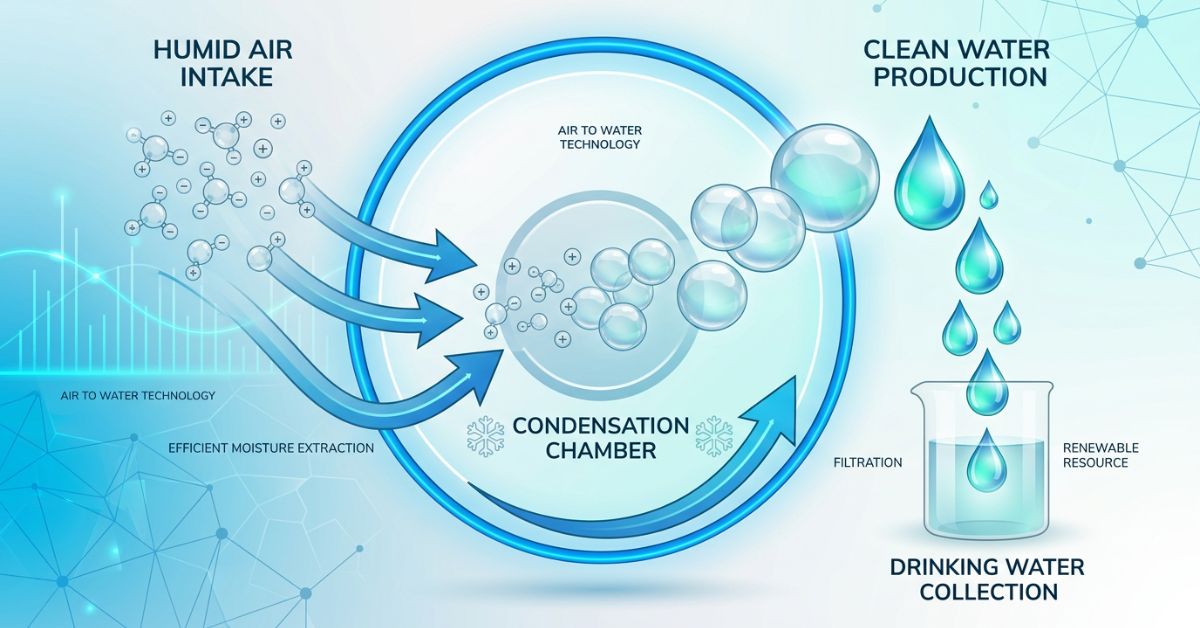
An Atmospheric Water Generator (AWG) is a device that extracts moisture from the surrounding air and converts it into clean, drinkable water.
Here is how the process works:
• Ambient air is drawn into the system through an intake fan and pre-filter
• The air is cooled below its dew point temperature, causing water vapor to condense into liquid droplets
• Collected water passes through multi-stage filtration and purification
• Mineralization restores essential minerals, producing safe, balanced drinking water
AWGs essentially replicate the natural process of condensation — the same science behind morning dew — but in a controlled, hygienic, and scalable manner.
Crucially, AWGs can produce water without relying on:
• Borewells or groundwater extraction
• Municipal pipeline supply
• Water tanker deliveries
That independence is what makes them genuinely revolutionary.
Why AWGs Are a Promising Solution for India
1. No Dependency on Groundwater
India is the world's largest user of groundwater, and reserves in several states are critically depleted. AWGs offer a completely independent source by producing water from atmospheric moisture, imposing zero additional stress on aquifers.
2. Clean and Safe Drinking Water
Modern AWGs incorporate multi-stage filtration, UV sterilization, and controlled mineralization to consistently deliver safe drinking water. This directly addresses one of India's most persistent problems — water contamination — which affects millions across both rural and urban areas.
3. Deployable Across Urban and Remote Areas
AWGs can be installed in a wide variety of settings:
• Homes and residential apartments
• Offices and commercial buildings
• Schools and healthcare facilities
• Remote villages and tribal areas lacking pipeline infrastructure
This versatility makes them especially valuable where pipelines or reliable clean water sources are absent.
4. Eco-Friendly and Sustainable
Unlike bottled water or tanker supply, AWGs produce no plastic waste, require no water transportation, and extract nothing from the ground. Some advanced systems operate entirely on solar energy, making them a genuinely sustainable solution for water-stressed communities.
5. Reliable During Shortages and Emergencies
AWGs can serve as an effective backup during water shortages, natural disasters, or public health emergencies, providing immediate access to drinking water when conventional supply chains fail.
Real-World Use of AWGs in India
Atmospheric water generation is not merely theoretical - it is already operational in India across multiple sectors:
• Installed at select railway stations, airports, and public spaces
• Used by defense establishments and armed forces in remote locations
• Deployed in corporate campuses and residential buildings
Depending on the model and ambient conditions, AWG systems are capable of producing anywhere from 30 to over 1,000 litres of water per day, demonstrating that the technology is both practical and scalable for diverse Indian requirements.
Limitations of Atmospheric Water Generators
While AWGs offer significant promise, they are not a complete standalone solution at present. Key limitations include:
1. Dependence on Ambient Humidity
AWGs perform most efficiently in environments where relative humidity exceeds 60%. In arid regions such as Rajasthan, parts of Gujarat, or the Deccan Plateau, where humidity frequently drops below this threshold, water output per unit of energy consumed is substantially lower. This is a thermodynamic constraint — there is simply less moisture in drier air to condense.
2. Energy Consumption
AWGs require electricity to operate the refrigeration and fan systems. This increases operational costs, particularly at scale. However, this challenge is actively being addressed through:
• Integration with solar photovoltaic (PV) systems
• Energy-efficient compressor designs and heat exchange improvements
3. Higher Initial Investment
The upfront procurement and installation cost of AWGs can be higher than conventional alternatives. However, over a multi-year period, they can meaningfully reduce expenditure on tanker water, bottled water, and infrastructure maintenance.
4. Not Suited for Large-Scale Agricultural or Industrial Water Demand
AWGs are most appropriate for drinking water production. They are not currently viable as a source for agricultural irrigation or large-scale industrial water consumption, where volumes required are orders of magnitude higher.
Can AWGs Solve India's Water Crisis?
The honest answer: Yes - but not in isolation.
Atmospheric Water Generators are not a silver bullet. They are, however, a powerful and practical component of a broader solution. They can:
- Provide safe, reliable drinking water to homes and communities
- Reduce dependence on over-exploited groundwater
- Support both urban centres and remote or underserved areas
- Serve as an emergency backup during water crises
But to comprehensively address India's water crisis, AWGs must work in combination with:
• Rainwater harvesting and rooftop collection systems
• Wastewater treatment and recycling
• Upgraded urban water infrastructure
• Strong national and state government water policy frameworks
The Future of Water in India
India is moving toward a future in which water independence will become a practical necessity rather than a luxury. With growing awareness of water security risks and rapid advancements in AWG technology, adoption is accelerating across residential, commercial, and institutional sectors.
Research indicates that a significant number of Indian cities - particularly those in humid coastal and eastern states - have atmospheric conditions well-suited to efficient AWG operation, making this a viable long-term solution for millions of households.
This points to a clear and important shift: toward decentralized, self-sufficient water systems, where each home, building, or community can generate its own safe drinking water independently of external infrastructure.
Why Aeronero Is the Future of Water
At Aeronero, we believe in creating sustainable, independent, and reliable water solutions for Indian homes and businesses. Our Atmospheric Water Generators are designed to:
• Deliver pure, mineral-rich drinking water consistently
• Minimize environmental impact throughout the product lifecycle
• Provide genuine water security regardless of local supply conditions
• Perform reliably under the specific humidity and temperature conditions found across India
Instead of relying on uncertain municipal supply or groundwater, Aeronero empowers you to create your own water - anytime, anywhere.
Final Thoughts
India's water crisis is real - and it is intensifying.
But so are the solutions.
Atmospheric Water Generators represent a meaningful shift: from dependency to independence, from scarcity to innovation. While they may not replace every element of a national water system, they offer something of profound value:
Direct control over your own water source.
And in a future where water security will define quality of life, that control may well be everything.